
-
 The Emperor of All Maladies $18.09
 -

-
-

-

-

-

-

-

-

-

-

-

-

-

-
-

-

-

-

-

-

-

-

-

-
-
 The Urban Design Reader $116.08
 -
-23%
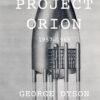
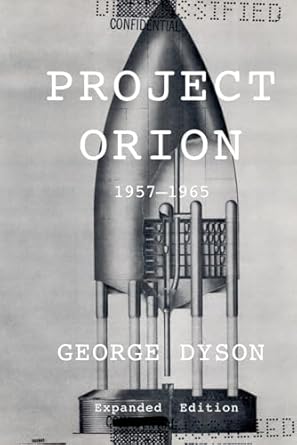
PROJECT ORION: 1957-1965
$25.85 Save:$8.00(23%)
Available in stock
| Print length: | 401 pages |
|---|---|
| Language: | English |
| Publication date: | 9 February 2025 |
| Dimensions: | 15.24 x 2.57 x 22.86 cm |
| ISBN-13: | 979-8218580841 |

Additional information
| Format | Paperback |
|---|
Description
SINGLE STAGE TO SATURN In 1957, in response to Sputnik and in advance of NASA, a small group of scientists and engineers, led by Theodore B. Taylor at a startup named General Atomic, launched an attempt to build an interplanetary spaceship powered by nuclear bombs. They aimed to reach Mars by 1965 and Saturn by 1970, in 4,000-ton ships carrying payloads of 1,000 tons. Project Orion , based on hundreds of hours of interviews and thousands of pages of declassified documents, reveals their story firsthand. This expanded edition includes a revision of the long out-of-print 2002 text (with updated notes, references, index, and a chronological listing of technical reports), a new foreword by Freeman Dyson, a new afterword, 52 pages of illustrations, and 12 previously unpublished manuscript calculation sheets. “Preliminary studies have indicated that it is conceivable to use nuclear bombs as the energy source to propel a very large, manned vehicle to very high velocities,” begins the ARPA contract that was signed on June 30, 1958. “If the concept is feasible, it may be possible to propel a vehicle weighing several thousand tons to velocities several times earth escape velocities. Such a vehicle would represent a major advance.” Eighteen months later, Freeman Dyson, a co-founder of the project, “went once again to Washington to talk with the very high authorities about our space-ship,” when the ARPA funding was running out. “The people were sympathetic but said there is virtually no chance that the thing will be pushed ahead during the next few years. The time will certainly come one day when the work will be renewed . . . but for the next few years there is nothing more I can do. Ted and I agreed that if the work is stopped the thing for us to do is to write a book.” Project Orion is the book that Dyson and Taylor could not publish at the time. It chronicles the genesis of the idea with Stanislaw Ulam at Los Alamos, the first two years of work, under ARPA, during which the project had a realistic, pre-Apollo chance, followed by the six years that a group led by Taylor kept working, against all odds, under U.S. Air Force support. The story has three angles: the physics and engineering behind how Orion would have worked (or failed); the people, from 14 different countries, who signed on to help; and the Cold War political landscape in which the proposal found serious high-level support. All direct quotations (and illustrations) are referenced either to primary source documents or to interviews with eyewitnesses to these events. Taylor was a mild-mannered Los Alamos physicist who, without a PhD, had designed the largest, the smallest, and the most efficient of U.S. fission bombs. “He didn’t play big shot,” remembers Jaromir Astl, one of his engineers, “He played one of the guys.” Freeman Dyson, also without a PhD, coined the project’s motto, “Saturn by 1970,” and planned to join the crew of at least fifty people who would be making the five-year trip. “Interest in the project is still alive as memories of it are fading,” Freeman Dyson writes in the foreword to this new edition. “I am still frequently asked whether I believe it has a future. I am asked whether I share a hope that some new version of Orion might take us to the stars. I am asked whether our dreams of fifty years ago are dead. The answer to all three questions is no.” “Why revisit this path not taken into space?” asks George Dyson in a new afterword. “The Cold Warriors who brought us Project Orion are here to remind us that the powers of nuclear weapons once rested in the hands of those who had borne personal witness to atmospheric tests. In passing these weapons on to a generation that has never seen a nuclear explosion firsthand, theirs is knowledge we must not forget.” —- ISBN: 9798218580841 | ISBN10: B0DWVF1P9M | ISBN-13: 979-8218580841