

Your bag is empty
Don't miss out on great deals! Start shopping or Sign in to view products added.
Shop What's New Sign in$42.17 Save:$17.00(30%)
Available in stock
| Language: | English |
|---|---|
| Publication date: | 30 July 2024 |
| Dimensions: | 13.97 x 1.04 x 21.59 cm |
| ISBN-13: | 979-8334550759 |
| Format | Hardcover |
|---|
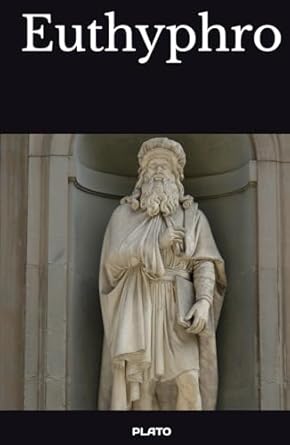
Euthyphro is a philosophical dialogue written by the ancient Greek philosopher Plato. It is set just before the trial of Socrates, one of the central figures in Western philosophy, and takes place outside the court in Athens. The dialogue is named after Euthyphro, a religious expert who encounters Socrates and engages in a discussion on the nature of piety and justice. The dialogue begins with Socrates meeting Euthyphro, who is there to prosecute his own father for manslaughter. Surprised by Euthyphro’s decision to charge a family member, Socrates questions him about the nature of piety, as Euthyphro claims to possess expert knowledge on religious matters. This sparks a conversation where Socrates, known for his method of elenchus (Socratic questioning), seeks to understand the essence of piety. Euthyphro first defines piety as what he is doing—prosecuting the wrongdoer, regardless of familial ties. Socrates, however, pushes for a more universal definition, seeking the characteristic that makes all pious actions pious. Euthyphro then suggests that piety is what is dear to the gods, but Socrates challenges this by pointing out that the gods often disagree among themselves. This leads to the famous Euthyphro dilemma: is something pious because the gods love it, or do the gods love it because it is pious? The dialogue continues with Socrates and Euthyphro examining and rejecting several definitions of piety, as each falls short under scrutiny. Socrates’ questioning reveals the complexity and ambiguity in defining moral concepts, highlighting the challenges of understanding the essence of virtue and piety. Euthyphro is not just a philosophical inquiry into piety; it also serves as a critical examination of religious and moral beliefs, illustrating Socrates’ commitment to questioning and seeking knowledge. The dialogue ends inconclusively, with Euthyphro departing in frustration and Socrates still in search of a satisfactory definition of piety. This open-ended conclusion reflects Plato’s broader philosophical method, encouraging readers to engage with the ideas and question their own assumptions. Overall, Euthyphro is a foundational text in the study of ethics and philosophy, exploring deep questions about morality, the nature of the divine, and the relationship between religious beliefs and ethical principles. It is an essential work for understanding Socratic philosophy and the intellectual climate of ancient Athens. —- ISBN: 9798334550759
Only logged in customers who have purchased this product may leave a review.








Reviews
There are no reviews yet.