
Your bag is empty
Don't miss out on great deals! Start shopping or Sign in to view products added.
Shop What's New Sign in$36.19 Save:$7.00(17%)
Available in stock
| ISBN-13: | 979-8324455835 |
|---|---|
| Publication date: | 30 April 2024 |
| Language: | English |
| Dimensions: | 21.59 x 0.61 x 27.94 cm |
| Print length: | 101 pages |
| Format | Paperback |
|---|
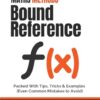
Feeling stressed about making your Maths Methods Bound Reference? It takes a LOT of time… Is it even worth it though? Some students say “”you won’t even use it””, yet many rely on it as a ‘safety net’. But spending too much time making the “”perfect”” bound reference comes at a cost – it eats into your valuable time for practicing exam questions. And we all know that’s the real secret of doing well in Methods. So, what if there was a bound reference that’s already made for you? One that’s ready to go so you can focus on what matters most – practicing questions and solidifying your understanding. Not stressing about what to include or how to organize it. (or cutting out and gluing pages together like it’s a craft project) Why this Methods bound reference? Organized by Topic: You’ll quickly find key concepts for each topic, saving precious exam time. Not Too Thick: With less than 100 pages, it covers everything you need to know without the fluff. Extra Formulas & Examples: Get extra formulas not found in your textbook, plus answers to some tricky exam questions. Easy to Navigate: The content page helps you find what you need during the exam. No more getting lost in your notes. But wait, can’t you just write your own bound reference? Sure, you can. But let’s be real, it takes a ton of time and effort. Time that could be spent practicing exam questions. Plus, deciding what to include can be overwhelming. There’s just so much content to cover. With this bound reference, you won’t have to worry. It’s all there – all the content you need to know, neatly summarized. Here’s what you’ll find inside: How to solve trig questions (multiple angles too) How to sketch various graphs (super important) SPAMI Method to sketch any trig function 2 ways to find the range of a composite function How to find the rule of an inverse function (and what to watch out for) How to find sequence of transformations given original and image function 3 different forms of the chain rule (you’ll use this a ton) 4 features of tangent and normal lines (you gotta know this) 3 key features of the derivative graph (vital concept) 2 ways to identify the nature of a stationary point (can’t skip this) How to find the absolute max/min value of a function (we’ve got you) How to find the max/min value with known/unknown functions (step by step) How to use Newton’s Methods formula (and when it doesn’t work) 3 harder examples where you need to find the area under a curve (and what formulas to use) How to find the average value for unknown functions (examiners love to ask this) How to find the mean and median of a discrete random variable How to recognize a binomial distribution (this shows up all the time) 7 must-know binomial rules for exam 1 (where no calculators are allowed) 3 Methods of finding the sample size n for a binomial distribution (these are usually the hardest binomial questions) Key properties of a probability density function (this is a must-know) Symmetric properties (with formulas) of a normal distribution How to find the probability of p hat (very common exam question) How to find confidence intervals and margin of error We’ve all been there – that moment in an exam when you have a mental blank. It’s a terrifying feeling. When you’re feeling the pressure in the exam room – under timed conditions – it’s easy to forget things. But with this bound reference, you can quickly get back on track and find your way through those questions. Remember, even using it just 3 times could mean 3 saved marks – and in exams, every single mark counts. —- ISBN: 9798324455835 | ISBN10: B0D3363JT4 | ISBN-13: 979-8324455835