
-

-
 The Emperor of All Maladies $18.09
 -
-
-

-
 The Urban Design Reader $116.08
 -
-

-

-
-

-

-

-
-
-

-
-
-

-

-

-
-27%
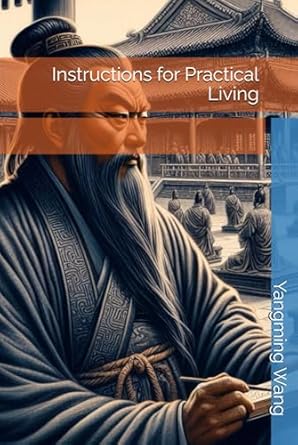
Instructions for Practical Living
$38.80 Save:$15.00(27%)
Available in stock
| Language: | English |
|---|---|
| Publication date: | 30 June 2024 |
| Dimensions: | 15.24 x 1.93 x 22.86 cm |
| ISBN-13: | 979-8329908084 |
Additional information
| Format | Hardcover |
|---|
Description
Instructions for Practical Living is a philosophical work compiled by Wang Yangming’s disciples based on his sayings and letters. Wang Yangming was a prominent philosopher of the Ming Dynasty and a representative of the Xinxue (Heart-Learning) school within Song-Ming Neo-Confucianism. This book records his sayings and letters on learning. The term “”Transmission of Learning”” is derived from the phrase “”Not transmitted, not learned”” in the Analects of Confucius. This book contains Wang Yangming’s main philosophical thoughts and is an important source for studying Wang Yangming’s thought and the development of Xinxue. The upper volume was reviewed by Wang Yangming himself, the letters in the middle volume were written by Wang Yangming himself and were his writings in his later years, and the lower volume was not reviewed by him, but explained his thoughts in later years in a more specific way and recorded the “”Four-Sentence Teachings”” proposed by Wang Yangming. “”The mind is the principle”” was originally a proposition of Lu Jiuyuan, and The Transmission of Learning elaborates on it. Wang Yangming criticized Zhu Xi’s method of self-cultivation as seeking the principle outside the mind, seeking the harmony of external things with the principle of heaven and the utmost good. Wang Yangming believed that “”the utmost good is the body of the mind,”” “”the mind is the principle, and this mind without the obscuration of selfish desires is the principle of heaven, and one does not need to add a single point outside.”” He said this to emphasize that the basis of ethical norms in society lies in the utmost good of the human heart. From this principle, his interpretation of the Great Learning is quite different from Zhu Xi’s. Zhu Xi believed that the “”investigation of things and the attainment of knowledge”” in the Great Learning requires students to ultimately understand the “”overall great use”” of the human heart through the knowledge of external things. Wang Yangming believed that the “”investigation of things”” is to “”remove the不正 of the mind and fulfill the正of its body.”” “”The body of intention is knowledge, and where intention is, there is the thing.”” “”Knowledge”” is inherent in the human heart, not something that comes from knowing external things. This knowledge is “”conscience.”” In his view, Zhu Xi’s theory of investigating things to the utmost is precisely to separate the mind and the principle. It can be seen from this that Wang Yangming’s proposition of “”the mind is the principle”” is mainly to serve his theory of self-cultivation. The “”Doctrine of the Great Learning”” is a development of Lu Jiuyuan’s thought of “”the mind is the principle.”” Wang Yangming’s thought of “”the mind is the principle”” also has our general sense of ontological meaning. However, if we focus on studying it from the perspective of ontology, we will ignore its basic significance in Wang Yangming’s theory of self-cultivation. The question of knowledge and action is an important issue discussed in this book, and it also reflects Wang Yangming’s further study of the discussion of this issue by Song-Ming Neo-Confucianism since Zhu Xi. He said: “”Seeking the principle outside the mind is why knowledge and action are two. Seeking the principle in our minds is the teaching of the sages that knowledge and action are one.”” The implication of “”knowledge and action are one”” is that knowledge and action are two aspects of the same thing. —- ISBN: 9798329908084
Reviews (0)
Only logged in customers who have purchased this product may leave a review.



Reviews
There are no reviews yet.