
Your bag is empty
Don't miss out on great deals! Start shopping or Sign in to view products added.
Shop What's New Sign in$20.58 Save:$6.00(22%)
Available in stock
| Print length: | 170 pages |
|---|---|
| Language: | English |
| Publication date: | 28 February 2025 |
| Dimensions: | 15.24 x 0.99 x 22.86 cm |
| ISBN-13: | 979-8308271895 |
| Format | Paperback |
|---|
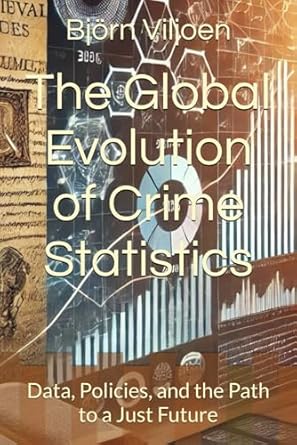
The Global Evolution of Crime Statistics: Data, Policies, and the Path to a Just Future offers a compelling exploration of how crime data has influenced the world, from its earliest forms to the sophisticated systems in use today. Written by someone who has worked in both business and law enforcement, the book provides a unique perspective on the importance of accurate, unbiased data and its role in shaping policies, justice systems, and society as a whole. The book emphasizes the parallels between business and law enforcement, both of which rely on data to make informed decisions. In business, data drives market analysis and strategy. In law enforcement, crime data informs decisions about prevention, detection, and resource allocation. However, the book argues that the stakes are even higher in crime statistics, as flawed or biased data can perpetuate inequalities, misinform policies, and erode public trust in justice systems. Through personal insights and professional experiences, the author examines the evolution of crime data, tracing its origins from early record-keeping in ancient civilizations to modern techniques such as crime mapping, predictive policing, and algorithmic decision-making. The narrative highlights how technological advances have transformed crime statistics into a powerful tool for justice, while also introducing new challenges related to ethics, privacy, and transparency. The book delves into the global nature of crime data, exploring how different regions—such as the USA, Europe, South America, Asia Pacific, and Australia—have approached its collection and use. It investigates the influence of international organizations, government policies, and independent bodies on the development of crime statistics, as well as the cultural, economic, and political factors that shape their interpretation. The author also examines the limitations of crime data, emphasizing the need for transparency and fairness in its collection and analysis. Challenges such as biases, inaccuracies, and systemic flaws are discussed, with examples of how these issues have led to misguided policies or disproportionately affected marginalized communities. The book argues that data alone cannot create justice; it must be paired with ethical practices and a commitment to equity. Through a critical lens, the book explores key questions about the role of crime data in shaping public perceptions of safety and justice. It scrutinizes the rise of predictive policing and its implications for fairness, as well as the broader societal impact of relying on data to make decisions that affect lives and liberties. Ultimately, The Global Evolution of Crime Statistics seeks to provide a deeper understanding of how crime data serves as both a reflection of society and a powerful force for change. It argues for a future where crime statistics are collected and analysed with precision and integrity, fostering fairness, accountability, and trust. By examining the history, challenges, and potential of crime data, the book illuminates a path toward a more informed and equitable future. This is not merely a historical account or technical guide but an exploration of the profound relationship between data, justice, and governance. It invites readers to consider how accurate and unbiased crime statistics can help create safer communities while addressing the root causes of inequality and injustice. —- ISBN: 9798308271895 | ISBN10: B0DV997P41 | ISBN-13: 979-8308271895